Tag Archives: leadership

Thinking Partners: A Concept and a Compact

Leaders should not underestimate the importance of Thinking Partners as they embark on new ways of learning and leading. As they continuously re-examine traditional leadership practices and test new mental models, leaders become vulnerable. Thinking Partners provides the structured reflection and safe means to evaluate leadership practices.

Thinking Partners is not simply a person or a role, but rather a concept that includes the roles of both partners and the structure of the conversation. It can be defined as a structured, thinking-sharing-listening-reflecting session in which:

  • one person thinks out loud
  • the other person listens and asks questions to deepen thinking

Thinking Partners is a Concept & a Compact
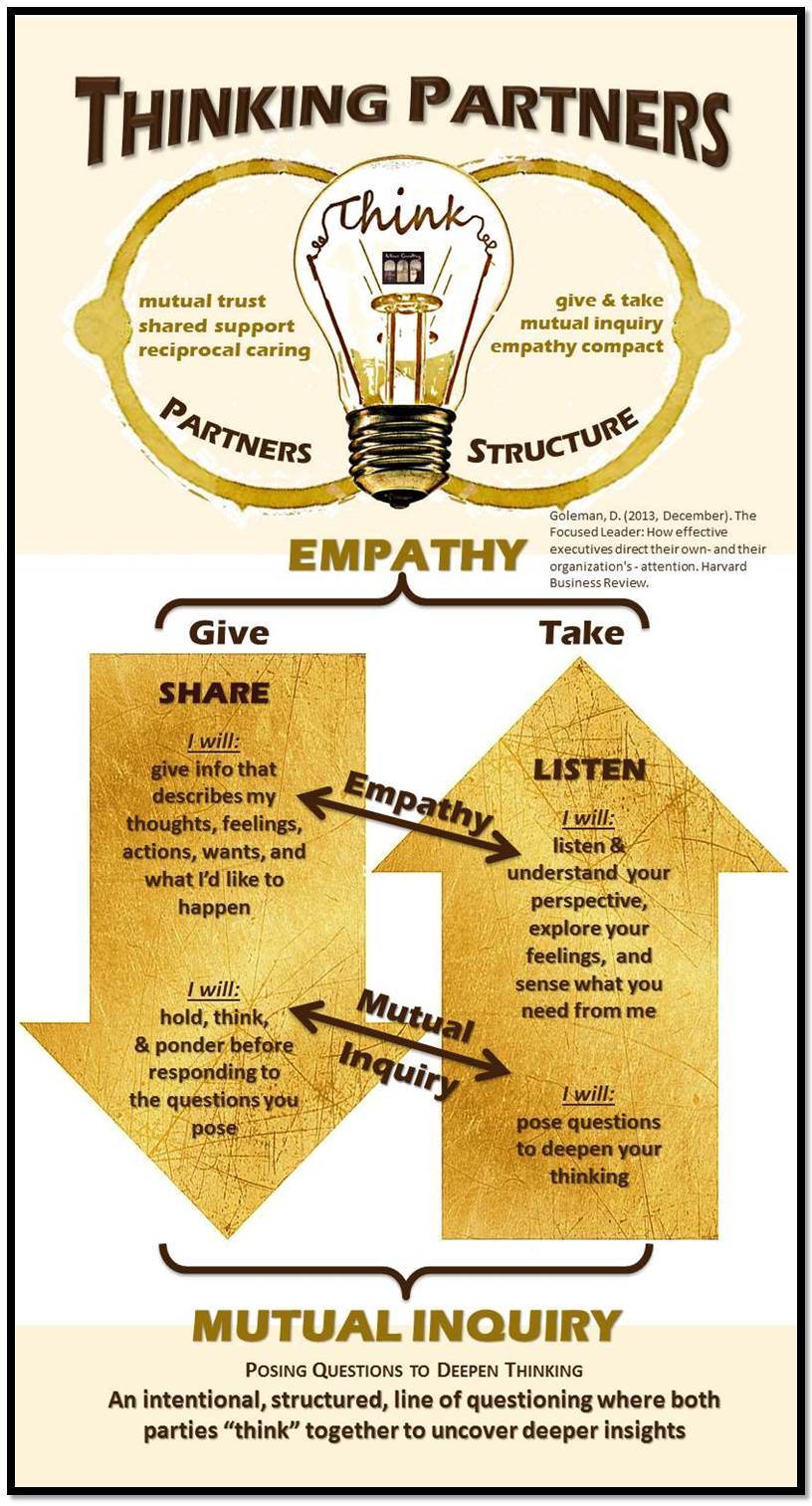
Thinking Partners is a Concept & a Compact in which two people engage in mutual inquiry while practicing empathy
Select a Thinking Partner

Look in your circle of influence for someone you are comfortable with. You and your thinking partner should:

  1. share mutual trust
  2. genuinely care for each other as individuals
  3. be able to support each other’s commitment statement
Agree on Structure

Thinking partner sessions are best done in person, but can be done in a video format like FaceTime or Skype. As a last resort you may speak by telephone. You and your thinking partner should agree to:

  1. practice empathy
  2. engage in mutual inquiry

What will you “think “about during the sessions? Possible topics are:

  • reaction to things you are trying
  • reflection on actions you have taken
  • new ideas you are considering
  • concerns you have
  • things you are avoiding

As you think out loud, your partner will listen with intent and then pose questions to deepen your thinking and offer you new perspectives.

Questions to Deepen your Thinking

  • Do you routinely include structured reflection in your work?
  • Do you ask others for help in “thinking things through”?
  • Do you look to others for new perspectives or to shift your thinking?

Related Posts

Mutual Inquiry: 8 Steps to Deepen & Shift Thinking
Transformational vs. Transactional: 2 Things a Leader Needs
Setting Meaningful Goals: 3 Components of a Commitment
The DOs and DON’Ts of Curious Listening: Tell Me More

Credits

Goleman, D. (2013, December). The Focused Leader:How effective executives direct their own – and their organization’s – attention. Harvard Business Review.
Knowles, M. (1984). The Adult learner: A neglected species. Houston: Gulf Publishing Company.


Networking: 5 Circles of Influence

We underestimate the amount of resources it takes to achieve commitments. And we are reluctant to ask for support. But, we need to ask in a deliberate way. How can you motivate others to work with you in achieving your commitments? By creating a community of supportive relationships.

If you include networking as part of your routine, then you will have the resources you need to achieve your commitments.

This means being intentional with your work relationships and knowing how each person connects to a common purpose. Once you have crafted your 2-minute story of commitment, make a list of whom you will share it with.

Determine your Circles of Influence

Make a list of people who need to hear your commitment. From your employees, colleagues, and stakeholders select people who can, directly or indirectly, help you reach your goals. Be sure to include names in each of the 5 circles:

If you include networking as part of your routine, then you will have the resources you need to achieve your commitments.


1- Start with People you trust.

This can be anyone who fits into the other four categories. This is someone you are comfortable with and someone whom you trust explicitly to give you objective feedback. Examples: friends, family, boss, colleagues

2- People you lead.

This is includes your direct reports and others you lead indirectly. Examples: employees, staff, volunteers, members

3- People you work/collaborate with.

These are people you don’t lead “officially” but whom you work with. Examples: peers, other departments, other organizations, vendors

4- People you need.

This group includes people who are not in groups 1-3. It may be stakeholders, people you need on your side, or people who have something that can help, and most importantly: PEOPLE WHO WILL NETWORK ON YOUR BEHALF.

5- People from the larger community.

These are people (or groups of people) who exist outside of your organization who influence or are influenced by your organization. Examples: professional organizations, board of directors, a community action group, your town, state or county

Create your Community

Begin sharing with people you are most comfortable with and continue through group 5. Start with at least 3 connections from each group. Revise your 2-minute story of commitment each time you tell it depending on your audience. Over a period of weeks or months, you will create a community of supportive relationships.

Questions to Deepen Your Thinking:

  • How is networking working for you?
  • How diverse is your network?
  • Can you think of a different way to grow your network?

Credits

Ganz, M. (2007). TELLING YOUR PUBLIC STORY: Self, Us, Now. Cambridge: Kennedy School of Government.
Ibarra, H. & Hunter M. (2007, January). How leaders create and use networks. Harvard Business Review.
Uzzi, B. & Dunlap, S. (2005, December). How to build your network. Harvard Business Review.

Related Posts:

How Leaders Inspire & Motivate: 2-Minute Story of Commitment

How can leaders inspire & motivate when sharing goals? By making each goal a 3-part commitment and sharing it as a 2-minute story. It takes more than telling others what your goals are. It is about being intentional about the way you share your commitment and how you connect to others as you do so.

If you share your commitment as a story, then you are more likely to inspire and motivate others.

Shared values connect us to each other. Stories inspire. So, once you have built your 3-part commitment, construct a 2-minute narrative that tells the story of your challenge, what is important, and the desired future.

Get Attention & Connect with Others through a 2-Minute Narrative How Leaders Inspire & Motivate: 2-Minute Story of CommitmentPart 1. Challenge

The first 90 seconds of your 2-minute story should describe a challenge you overcame successfully. Starting with a story will quickly get attention. Include details about time and place and tell them the challenge, what you did, and what the result was. Start with, “I’d like to tell you a story…

Part 2. Values

The next 10 seconds of your story should describe your value and how it connects with the common purpose of your audience. Start with, “I share this because … is important to us…”

Part 3. Strategic Outcome

Describe what the future will look like when your commitment is fulfilled and ask others to take action to help you get there. Start with, “Imagine if…” and “Please join me…”

Questions to Deepen Your Thinking:

  • How is ‘sharing your vision with others’ working for you?
  • What would happen if you shared your goals as an “imagine if…” story?
  • What are the consequences of others not knowing what you are committed to?

Credits

Ganz, M. (2007). TELLING YOUR PUBLIC STORY: Self, Us, Now. Cambridge: Kennedy School of Government
Denning, S. (2007). The Secret Language of Leadership: How Leaders Inspire Action Through Narrative. San Francisco: Jossey-Bass.

Related Posts

Setting Meaningful Goals: 3 Components of a Commitment

Goals will be more meaningful and achievable if you express them in the form of a commitment statement that you can share with others. Stephen Denning tells us:

“Not having a commitment that is clearly communicated is one of the top mistakes made by leaders.”

Committing to work on a goal from simply a performance perspective is a burden. Leaders need to include their values to be emotionally engaged in order to ignite their full range of talent. Marcus Buckingham tells us that “Focusing on strengths is the surest way to greater job satisfaction, team performance and organizational excellence.” 

Make your goal a 3-part commitment to get better results:

Commit to Meaningful Goals

1- Strength. What do you already do well?
Take advantage of what comes naturally to you and has a proven track record. Although research has shown that goals should build on one’s strengths, (not one’s weaknesses), fewer than 10% of executives have a plan for improving their strengths.

2- Value. What is important to you?
Values connect us to others around a common purpose. Crafting a commitment statement around what appeals to you is not only highly motivating but inspiring to others.

3- Strategic Outcome (goal). What will your goal look like?
Goals must be a person’s own, not goals imposed by someone else. But they do need to be aligned with organizational goals and feasible within your work environment.

Questions to Deepen Your Thinking

  • How is ‘achieving your commitments’ working for you?
  • Can you think of a different way to describe what you are committed to?
  • What would happen if your commitment had a strength and a personal value built in, instead of just a performance outcome?

Credits

Craig, N. & Snook, S. (2014, May). From purpose to impact: Figure out your passion and put it to work. Harvard Business Review, 105-111.
Denning, S. (2007). The Secret Language of Leadership: How Leaders Inspire Action Through Narrative. San Francisco: Jossey-Bass.
Goleman, D., Boyatzis, R. & McKee, A. (2002). Primal Leadership: Learning to Lead with Emotional Intelligence. Boston: Harvard Business School Press.
Marcus Buckingham, http://www.tmbc.com/offer/strengths
Zenger, J., Folkman, J. & Edinger, S. (2011, October). Making Yourself Indespensible. Harvard Business Review , 85-92.

Related Posts

Transformation: How to Spot it in Your Organization

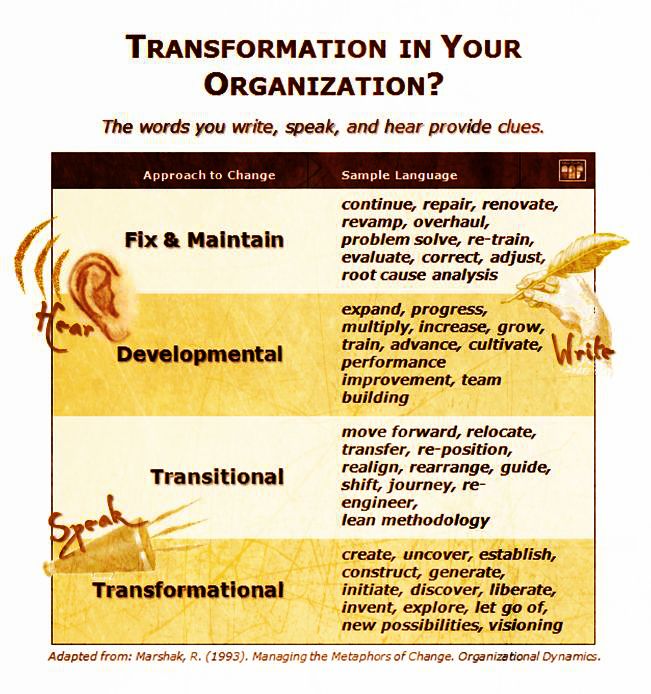
Is your strategic plan transformational? You can tell by your language. The words you write and speak and the imagery around those words provide clues. Robert Marshak identified 4 metaphors for organizational change, and reveals distinctive language used to describe and define each.

How to Spot Transformation in Your Organization

The language you use are clues to your change approach: fix & Maintain, Developmental, Transitional, or Transformational

At different times there may be need for all four approaches. Once you determine what type of change is needed, check to see if your language matches.

Questions to Deepen Your Thinking:

  • What words are you speaking and writing in your organization?
  • What language do you use in formal documents and informal conversation?
  • Does your language match your approach?

Related Posts

Transformational vs Transactional: 2 Things a Leader Needs

Credits

Marshak, R. (1993). Managing the Metaphors of Change. Organizational Dynamics.