The DOs & DON’Ts of Curious Listening: Tell Me More

If you are a leader, you are in the relationship business. Whether a colleague, client, vendor, front-line worker, or networking connection, you interact with people every day. If, in your interactions, you are mindful about making a human connection, you will establish the foundation for a positive, beneficial relationship. A key to making that connection is listening—and listening takes practice.

Curious Listening

Edgar Schein refers to Humble Inquiry as asking questions from an attitude of genuine curiosity and interest about the other person. In this post, we will focus on the listening part of Humble Inquiry. We call it “curious listening.” This type of listening is more than just hearing or being attentive and it is not the kind of listening where you expect to gain knowledge. It is a higher level of listening that Otto Scharmer describes as “seeing from our deepest source” and what Daniel Goleman refers to as “emotional empathy.”
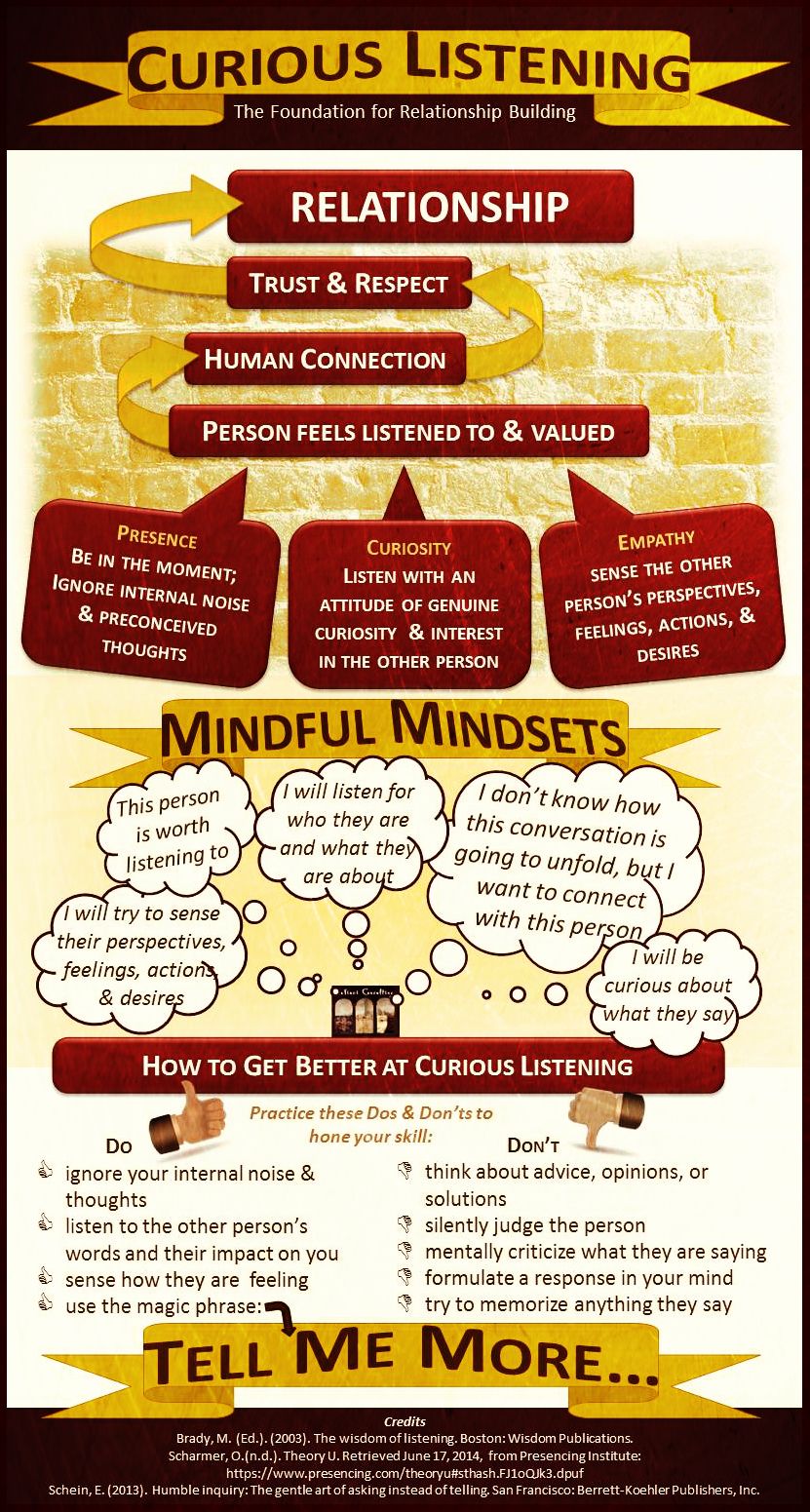
Perfecting the skill of curious listening takes time and it takes active energy. Practice by being intentional about the following DOs & DON'Ts:


The aim of curious listening is not about what we hear, per se; it is about the other person feeling valued.

If leaders approach an interaction with the mindset that the conversation is worthwhile, then the other person will feel “listened to” and a connection is made.

Preparing to Listen: Mindful Mindsets

Prepare for curious listening by taking the time to stop, slow down, and consider the following mindsets (or mantras, if you will):

  • This person is worth listening to
  • I don’t know how this conversation is going to unfold, but I want to connect with this person
  • I will listen for who they are and what they are about
  • I will be curious about what they say
  • I will try to sense their perspectives, feelings, actions, and desires
How to Get Better at Curious Listening

Perfecting the skill of curious listening takes time and it takes active energy. Practice by being intentional about the following DOs & DON’Ts:

DO:
  • ignore your internal noise and thoughts
  • listen to the other person’s words and their impact on you
  • sense how the other person is feeling
DON’T:
  • formulate a response in your mind
  • think about advice, opinions, or solutions
  • silently judge or criticize the person or what they are saying
  • feel the need to memorize anything they say

Questions to Deepen Thinking

What would happen to your interactions if you focused on curiosity and did not think ahead about your response?
What will you get if you try this script the next time you interact with someone? “Hmm… Tell me more!”
What are the consequences of not truly listening to the people you interact with?

Credits

Brady, M. (Ed.). (2003). The wisdom of listening. Boston: Wisdom Publications.
Goleman, D. (2013, December). The Focused Leader:How effective executives direct their own – and their organization’s – attention. Harvard Business Review.
Scharmer, O. Theory U. Retrieved June 17, 2014, from Presencing Institute: https://www.presencing.com/theoryu#sthash.FJ1oQJk3.dpuf
Schein, E. (2013). Humble inquiry: The gentle art of asking instead of telling. San Francisco: Berrett-Koehler Publishers, Inc.

Related Posts

Networking: 4 Steps to Making Strategic Connections
Thinking Partners: A Concept and a Compact
Mutual Inquiry: 8 Steps to Deepen & Shift Thinking

Networking: 4 Steps to Making Strategic Connections

Strategic contacts are often people with whom you have no mutual connection. The bad news: For many, reaching out to these people is an overwhelming task that causes high anxiety. The good news: It can be mastered with structure and practice and it has a high return on investment.  

Once you have identified people to connect with, what do you say to them? How do you introduce yourself? The more you practice the following steps the easier it will get and the more likely you are to make it part of your ongoing leadership practice.4 steps to making strategic connections: Initial Contact, Curious Listening, 2-minute story, & follow-up

4 Steps to Make a Connection

1. Initial Contact: Whether in person or electronically, use your commitment statement as a way to introduce yourself and ask for a meeting. Tell them what you are committed to, what you are passionate about, and what you are working towards. Mention your common connection and request some time to meet. For example:

“I got your name from … I am committed to … so that … Can we meet for coffee to talk more?”

2. Your Story: During the “get-acquainted” meeting, share your 2-minute story of commitment so the other person can learn about you. Tell them about a challenge you overcame, your shared purpose, and your desired future. For example:

“I’d like to tell you a story… I share this because … is important to us … Imagine if … Please join me … ”

3. Their Story: Use curious listening to learn about the other person. Everyone has a story to tell. Encourage them to share theirs. Ask questions and listen. Look for something that resonates with you– work or non work related. People most often bond through interactions about personal interests, not technical ones. For example:

“I’m curious … Tell me more … Go on … That is interesting … ”

4. Follow-up: Show your appreciation by thanking them for the meeting using ongoing regard. Describe specifics about the meeting and then describe what impact it had on you. Written notes are best, but email also works. For example:

“Thank you … I appreciate …What you said/did … It made a difference in …”

 Questions to Deepen Thinking

  • How are you doing with making new connections?
  • What would happen to your leadership practice if you stopped strategic networking?
  • Have you ever tried to make a connection simply by being curious about the other person?Credits
Battilana, J. & Casciaro, T. (2013, July-August). The network secrets of great change agents. Harvard Business Review.
Ibarra, H. & Hunter, M. (2007, January). How leaders create and use networks. Harvard Business review.
Kegan, R. &. Lahey, L. (2001). How the Way We Talk Can Change the Way We Work: Seven Languages for Transformation. San Francisco: Jossey-Bass.
Schein, E. (2013). Humble inquiry: The gentle art of asking instead of telling. San Francisco: Berrett-Koehler Publishers, Inc.
Uzzi, B. & Dunlap, S. (2005, December). How to build your network. Harvard Business Review.

Related Posts

Strategic Networking: ABCs of Choosing Your Connections
Networking: 5 Circles of Influence
How Leaders Inspire & Motivate: 2-Minute Story of Commitment
Setting Meaningful Goals: 3 Components of a Commitment
The DOs and DON’Ts of Curious Listening: Tell Me More
Ongoing Regard: Boost the Power of your Thank You 

Strategic Networking: ABCs of Choosing Your Connections

Leaders cannot ignore the informal, yet powerful, impact that networks have on their success. Savvy leaders continuously seek resources, perspectives, and insights from individuals with diverse affiliations, backgrounds, and incentives. By adding the ABCs of strategic connections– Advocates, Ambassadors, Brokers, Champions, and Connecters– to your network, you will be better prepared for future challenges and priorities.

If you think towards the future when building your network, then you will be more prepared for future challenges and priorities.      

If more than 65% of your network is supportive, your network is probably too tactical. It is important to invest time in “strategic” networking.

Where to Look for Strategic Contacts

Your supportive network is important in your daily work. However, if more than 65% of your network is supportive, your network is probably too tactical. It is important to invest time in “strategic” networking. Start by brainstorming with these questions: Who do I already know that can introduce me to other contacts? Are there similar organizations outside of my geographical area? Which industries or professions share the same interests as me? What services do my client demographics use? Are there educator or academic connections that can be mutually beneficial? Who in particular can help me with my strategic goals?

Who to Connect With

It can be difficult to approach people with whom you have no common task or shared purpose, especially with more senior people. But, powerful contacts are not necessarily those in positions of authority or within your industry. Look for people or groups who:

  • publicly support your work or your commitments
  • are messengers or representative of your profession
  • can act and speak well on your behalf
  • already support similar endeavors
  • can arrange or negotiate introductions
  • can link you to another network
How to Make Contact

Create opportunities for connecting with those people you have identified. If you can’t find any common ground, do some research about the person. Join social or professional activities they participate in. Get involved in person and on-line. LinkedIn is a great platform for making new connections. Ask yourself and others within your circles of influence, “Who do I know that might be able to connect me with that person?” If you cannot find a common connection, read our next post for a step-by-step guide on how to approach your connections and what to say when you meet them.

Questions to Deepen Thinking

  • What percentage of your network is strategic?
  • When selecting strategic contacts, what would happen if you chose them based on your desired future?
  • What can you do differently to grow your network?

Credits

Battilana, J. & Casciaro, T. (2013, July-August). The network secrets of great change agents. Harvard Business Review.
Ibarra, H. & Hunter, M. (2007, January). How leaders create and use networks. Harvard Business review.
Uzzi, B. & Dunlap, S. (2005, December). How to build your network. Harvard Business Review.

Related Posts

Mutual Inquiry: 8 Steps to Deepen & Shift Thinking

Posing questions to deepen thinking is a valuable leadership practice. It is one of the most powerful ways to help others shift their thinking and see new perspectives. It is an art and skill that can be mastered with practice.

If you pose reflective questions and encourage the other person to pause and think before responding, then you will both begin to shift your thinking and uncover new perspectives.

Questions to deepen thinking are not meant to be “asked” and “answered.” They are designed to be “posed” and “responded to.” The dynamic of posing a question that is 1) not leading, diagnostic, or challenging and 2) not required to be answered; leads to deeper thinking, automatically.

Questions to deepen thinking are not meant to be “asked” and “answered.” They are designed to be “posed" and “responded to." The dynamic of posing a question that is 1) not leading, diagnostic, or challenging and 2) not required to be answered; leads to deeper thinking, automatically.
Pose Rather than Ask

“Asking”a question implies that you are requesting information or an answer. “Posing” a question, on the other hand, introduces a thought for consideration.  Derived from the Latin for pause, posing a question sets the tone for introspection and allows the other person to reflect.

Respond Instead of Answer

Think of a response as “thinking out loud.”  A response doesn’t require an answer or a solution. It is simply uttering something in reply as a means to continue the thought process and the conversational exchange.

Questions to Deepen Thinking

  • Have you ever intentionally asked a question that you did not want an answer to?
  • Have you ever resisted the urge to answer a question to allow time for reflecting?
  • When instructed to hold an answer for a period of time, how many times does your response change in your head?

Credits

Block, P. (2008). Community: The structure of belonging. San Francisco: Berrett-KoehlerPublishers, Inc.
Koffman, F. (n.d.). Advocacy and inquiry: Combining the basic steps of the dance of communication. Retrieved from Conscious Business Blog: http://www.axialent.com/uploads/paper/archivo/Advocacy_and_Inquiry_by_Fred_Kofman.pdf


Related Posts

Thinking Partners: A Concept and a Compact
The DOs and DON’Ts of Curious Listening: Tell Me More

Thinking Partners: A Concept and a Compact

Leaders should not underestimate the importance of Thinking Partners as they embark on new ways of learning and leading. As they continuously re-examine traditional leadership practices and test new mental models, leaders become vulnerable. Thinking Partners provides the structured reflection and safe means to evaluate leadership practices.

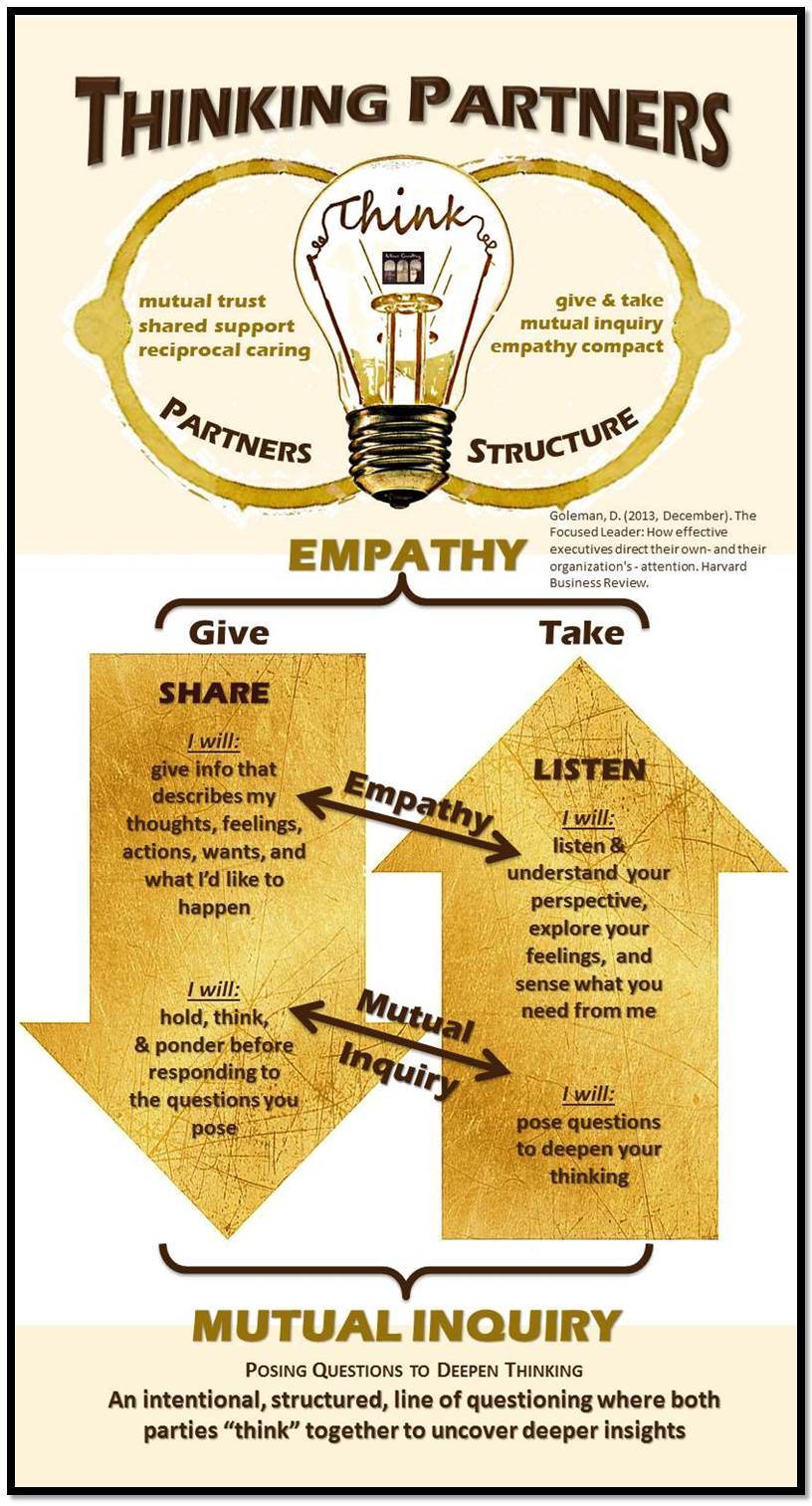
Thinking Partners is not simply a person or a role, but rather a concept that includes the roles of both partners and the structure of the conversation. It can be defined as a structured, thinking-sharing-listening-reflecting session in which:

  • one person thinks out loud
  • the other person listens and asks questions to deepen thinking

Thinking Partners is a Concept & a Compact

Thinking Partners is a Concept & a Compact in which two people engage in mutual inquiry while practicing empathy
Select a Thinking Partner

Look in your circle of influence for someone you are comfortable with. You and your thinking partner should:

  1. share mutual trust
  2. genuinely care for each other as individuals
  3. be able to support each other’s commitment statement
Agree on Structure

Thinking partner sessions are best done in person, but can be done in a video format like FaceTime or Skype. As a last resort you may speak by telephone. You and your thinking partner should agree to:

  1. practice empathy
  2. engage in mutual inquiry

What will you “think “about during the sessions? Possible topics are:

  • reaction to things you are trying
  • reflection on actions you have taken
  • new ideas you are considering
  • concerns you have
  • things you are avoiding

As you think out loud, your partner will listen with intent and then pose questions to deepen your thinking and offer you new perspectives.

Questions to Deepen your Thinking

  • Do you routinely include structured reflection in your work?
  • Do you ask others for help in “thinking things through”?
  • Do you look to others for new perspectives or to shift your thinking?

Related Posts

Mutual Inquiry: 8 Steps to Deepen & Shift Thinking
Transformational vs. Transactional: 2 Things a Leader Needs
Setting Meaningful Goals: 3 Components of a Commitment
The DOs and DON’Ts of Curious Listening: Tell Me More

Credits

Goleman, D. (2013, December). The Focused Leader:How effective executives direct their own – and their organization’s – attention. Harvard Business Review.
Knowles, M. (1984). The Adult learner: A neglected species. Houston: Gulf Publishing Company.