Category Archives: Leadership

How Leaders Inspire & Motivate: 2-Minute Story of Commitment

How can leaders inspire & motivate when sharing goals? By making each goal a 3-part commitment and sharing it as a 2-minute story. It takes more than telling others what your goals are. It is about being intentional about the way you share your commitment and how you connect to others as you do so.

If you share your commitment as a story, then you are more likely to inspire and motivate others.

Shared values connect us to each other. Stories inspire. So, once you have built your 3-part commitment, construct a 2-minute narrative that tells the story of your challenge, what is important, and the desired future.

Get Attention & Connect with Others through a 2-Minute Narrative How Leaders Inspire & Motivate: 2-Minute Story of CommitmentPart 1. Challenge
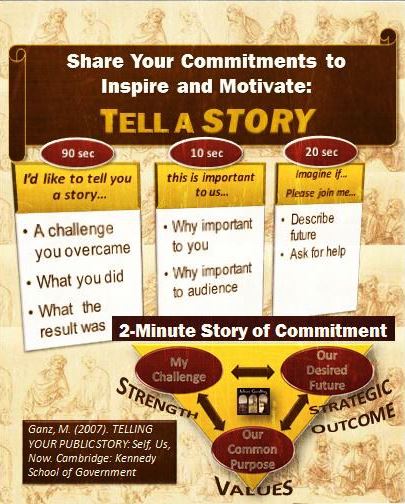
The first 90 seconds of your 2-minute story should describe a challenge you overcame successfully. Starting with a story will quickly get attention. Include details about time and place and tell them the challenge, what you did, and what the result was. Start with, “I’d like to tell you a story…

Part 2. Values

The next 10 seconds of your story should describe your value and how it connects with the common purpose of your audience. Start with, “I share this because … is important to us…”

Part 3. Strategic Outcome

Describe what the future will look like when your commitment is fulfilled and ask others to take action to help you get there. Start with, “Imagine if…” and “Please join me…”

Questions to Deepen Your Thinking:

  • How is ‘sharing your vision with others’ working for you?
  • What would happen if you shared your goals as an “imagine if…” story?
  • What are the consequences of others not knowing what you are committed to?

Credits

Ganz, M. (2007). TELLING YOUR PUBLIC STORY: Self, Us, Now. Cambridge: Kennedy School of Government
Denning, S. (2007). The Secret Language of Leadership: How Leaders Inspire Action Through Narrative. San Francisco: Jossey-Bass.

Related Posts

Setting Meaningful Goals: 3 Components of a Commitment

Goals will be more meaningful and achievable if you express them in the form of a commitment statement that you can share with others. Stephen Denning tells us:

“Not having a commitment that is clearly communicated is one of the top mistakes made by leaders.”

Committing to work on a goal from simply a performance perspective is a burden. Leaders need to include their values to be emotionally engaged in order to ignite their full range of talent. Marcus Buckingham tells us that “Focusing on strengths is the surest way to greater job satisfaction, team performance and organizational excellence.” 

Make your goal a 3-part commitment to get better results:

Commit to Meaningful Goals

1- Strength. What do you already do well?
Take advantage of what comes naturally to you and has a proven track record. Although research has shown that goals should build on one’s strengths, (not one’s weaknesses), fewer than 10% of executives have a plan for improving their strengths.

2- Value. What is important to you?
Values connect us to others around a common purpose. Crafting a commitment statement around what appeals to you is not only highly motivating but inspiring to others.

3- Strategic Outcome (goal). What will your goal look like?
Goals must be a person’s own, not goals imposed by someone else. But they do need to be aligned with organizational goals and feasible within your work environment.

Questions to Deepen Your Thinking

  • How is ‘achieving your commitments’ working for you?
  • Can you think of a different way to describe what you are committed to?
  • What would happen if your commitment had a strength and a personal value built in, instead of just a performance outcome?

Credits

Craig, N. & Snook, S. (2014, May). From purpose to impact: Figure out your passion and put it to work. Harvard Business Review, 105-111.
Denning, S. (2007). The Secret Language of Leadership: How Leaders Inspire Action Through Narrative. San Francisco: Jossey-Bass.
Goleman, D., Boyatzis, R. & McKee, A. (2002). Primal Leadership: Learning to Lead with Emotional Intelligence. Boston: Harvard Business School Press.
Marcus Buckingham, http://www.tmbc.com/offer/strengths
Zenger, J., Folkman, J. & Edinger, S. (2011, October). Making Yourself Indespensible. Harvard Business Review , 85-92.

Related Posts

Transformation: How to Spot it in Your Organization

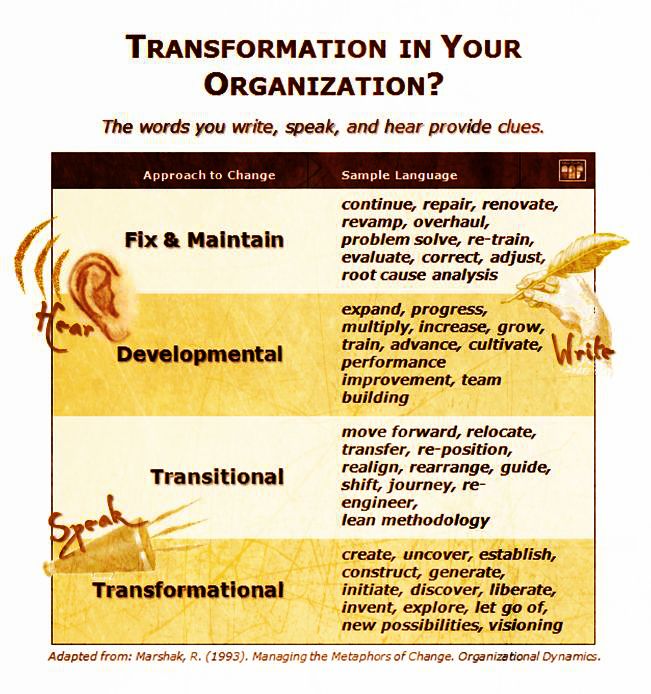
Is your strategic plan transformational? You can tell by your language. The words you write and speak and the imagery around those words provide clues. Robert Marshak identified 4 metaphors for organizational change, and reveals distinctive language used to describe and define each.

How to Spot Transformation in Your Organization

The language you use are clues to your change approach: fix & Maintain, Developmental, Transitional, or Transformational

At different times there may be need for all four approaches. Once you determine what type of change is needed, check to see if your language matches.

Questions to Deepen Your Thinking:

  • What words are you speaking and writing in your organization?
  • What language do you use in formal documents and informal conversation?
  • Does your language match your approach?

Related Posts

Transformational vs Transactional: 2 Things a Leader Needs

Credits

Marshak, R. (1993). Managing the Metaphors of Change. Organizational Dynamics.

Transformational vs. Transactional: 2 Things a Leader Needs

Your leadership is less likely to be transformational without work-related goals and guidance from another person. If left on your own, your leadership is apt to be transactional. So said David Pease, (SPHR- Executive VP/ CRO Androscoggin Bank), in Portland Maine last week. Pease went on to say, “As an HR leader, if you are only transactional you will eventually become irrelevant.”

As a leader you need structured reflection & meaningful goals.

 1- Structured Reflection. With a coach, thinking partner, or other person:
  • reflect on and evaluate your performance
  • recognize and deconstruct patterns
  • consider new perspectives
  • design new actions
2- Meaningful Goals. Commit to an outcome that:
  • is important to you and your organization
  • drives your day-to-day actions
  • helps you stay focused
  • you can share to inspire others

BF_Transformational_Infographic_logo

Questions to Deepen Your Thinking:

  • What are your goals as a leader?
  • Have you been intentional about declaring your goals as commitments?
  • Do you create time to reflect with someone about your leadership performance?

Related Posts:

Masterpiece Leader Blog

Coming March 18, 2014.