Monthly Archives: July 2014

Ongoing Regard: Boost the Power of Your Thank You

We cannot underestimate the ‘value of being valued.’  Saying thank you strengthens the bonds between people and re-emphasizes the personal relationship. But a thank you can be even more powerful if it contains the language of ongoing regard. Whether written or spoken it can be transformative for both the sender and receiver. Not only does ongoing regard make both parties feel good, it provides a deeper understanding of the behavior or action being recognized. That recognition is apt to inspire more of that same behavior in the future.

If you make another person feel valued, then they are more likely to support you and your work.

Be Direct.  Deliver your message directly to the recipient. Use the words thank you instead of I’d like to thank…
Be Specific. Describe the precise action you are thanking them for and not personal attributes like generous, helpful, and hard-working.
Reveal Impact. Describe the impact the action had on you, for example: it helped, added, enabled, made better. Avoid using feel-good phrases like, “always there when I need you” or “you did a great job.”
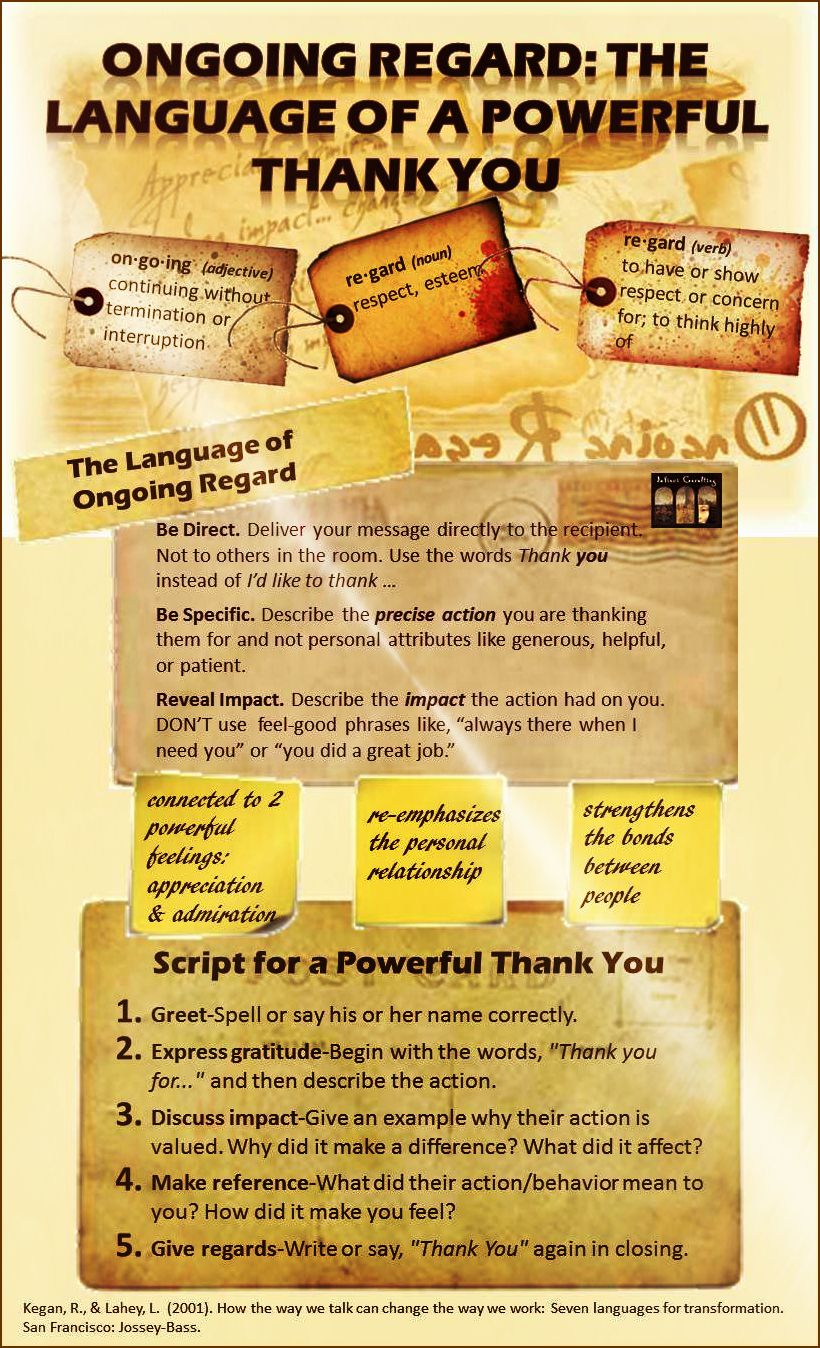
Boast the power of your thank you by describing the impact of the other person's action.

In preparation for delivering your powerful message, ask yourself the following questions:

  • Why do I want to thank this person?
  • What service/skill/behavior did they exhibit?
  • Why is it valuable?
  • How did their action impact my goals and commitments?

 Use the following 5 steps as a script to keep your thank you short and powerful.

  1. Greet. Spell or say his or her name correctly.
  2. Express gratitude. Start with the words, “Thank you for…” naming  the action/behavior you are thanking them for.
  3. Discuss impact. Describe a positive impact their action/behavior had.
  4. Make reference. What did their action/behavior mean to you? How did it make you feel?
  5. Give regards. Write or say, “Thank You” again in closing.
Things to Avoid

To ensure sincerity, stay away from the following:

  • Don’t use general phrases like, “Nice Job!” or “Thank you for all you did.”
  • Avoid the just writing trap. You are not “just writing to say”– that’s stating the obvious.
  • Don’t share unrelated news. This isn’t the time. This is exclusively about thanking someone for their actions or recognizing their behaviors.

 Questions to Deepen Thinking

  • How is ‘making your employees feel valued’ working for you?
  • What might happen if you start giving unexpected ongoing regard messages?
  • How might people feel if you regularly tell them the positive impact of their actions?
 References

Kegan, R., & Lahey, L.  (2001). How the way we talk can change the way we work: Seven languages for transformation. San Francisco: Jossey-Bass.

Related Posts

Networking: 4 Steps to Making Strategic Connections

The DOs & DON’Ts of Curious Listening: Tell Me More

If you are a leader, you are in the relationship business. Whether a colleague, client, vendor, front-line worker, or networking connection, you interact with people every day. If, in your interactions, you are mindful about making a human connection, you will establish the foundation for a positive, beneficial relationship. A key to making that connection is listening—and listening takes practice.

Curious Listening

Edgar Schein refers to Humble Inquiry as asking questions from an attitude of genuine curiosity and interest about the other person. In this post, we will focus on the listening part of Humble Inquiry. We call it “curious listening.” This type of listening is more than just hearing or being attentive and it is not the kind of listening where you expect to gain knowledge. It is a higher level of listening that Otto Scharmer describes as “seeing from our deepest source” and what Daniel Goleman refers to as “emotional empathy.”

Perfecting the skill of curious listening takes time and it takes active energy. Practice by being intentional about the following DOs & DON'Ts:


The aim of curious listening is not about what we hear, per se; it is about the other person feeling valued.

If leaders approach an interaction with the mindset that the conversation is worthwhile, then the other person will feel “listened to” and a connection is made.

Preparing to Listen: Mindful Mindsets

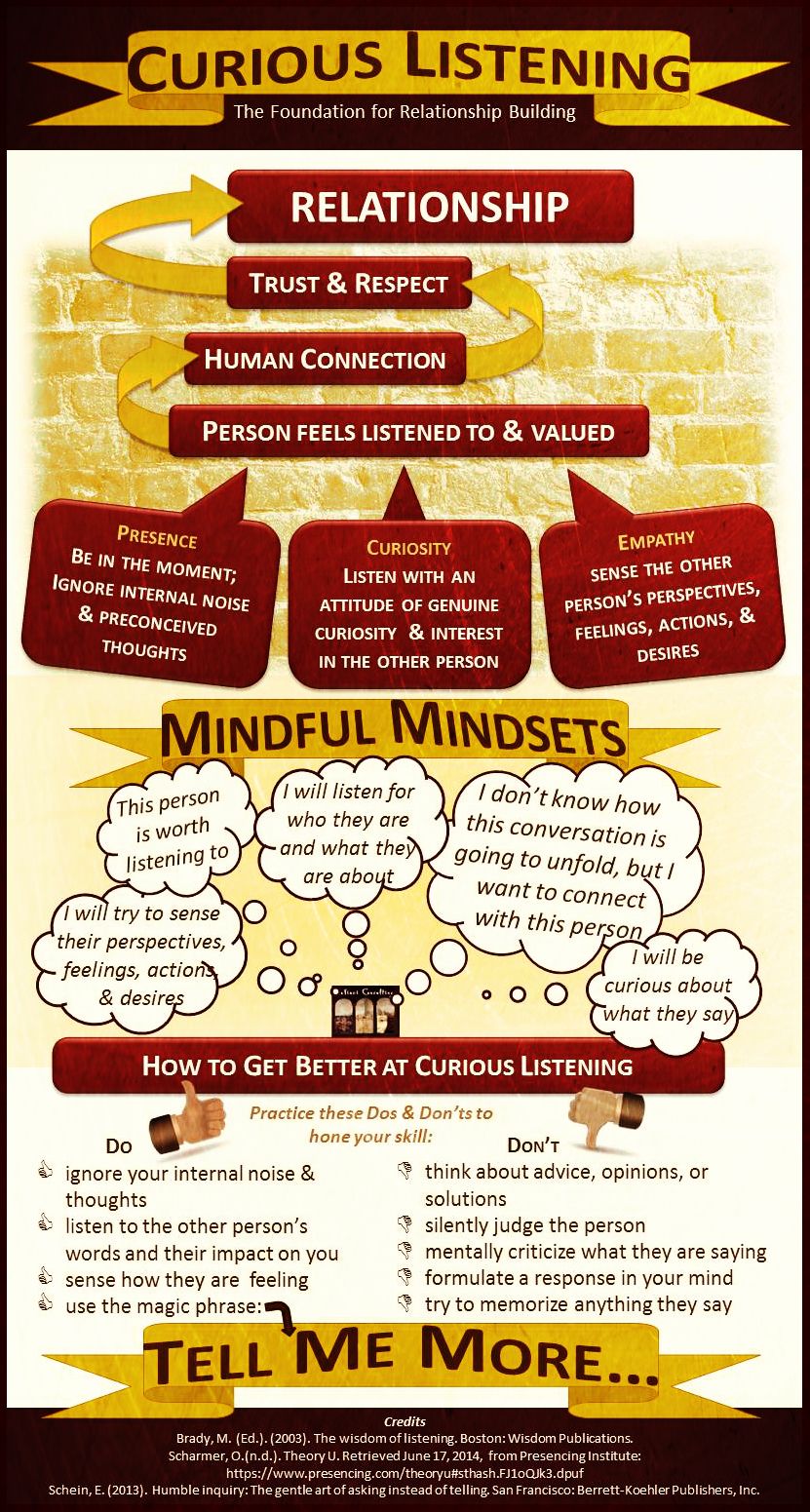
Prepare for curious listening by taking the time to stop, slow down, and consider the following mindsets (or mantras, if you will):

  • This person is worth listening to
  • I don’t know how this conversation is going to unfold, but I want to connect with this person
  • I will listen for who they are and what they are about
  • I will be curious about what they say
  • I will try to sense their perspectives, feelings, actions, and desires
How to Get Better at Curious Listening

Perfecting the skill of curious listening takes time and it takes active energy. Practice by being intentional about the following DOs & DON’Ts:

DO:
  • ignore your internal noise and thoughts
  • listen to the other person’s words and their impact on you
  • sense how the other person is feeling
DON’T:
  • formulate a response in your mind
  • think about advice, opinions, or solutions
  • silently judge or criticize the person or what they are saying
  • feel the need to memorize anything they say

Questions to Deepen Thinking

What would happen to your interactions if you focused on curiosity and did not think ahead about your response?
What will you get if you try this script the next time you interact with someone? “Hmm… Tell me more!”
What are the consequences of not truly listening to the people you interact with?

Credits

Brady, M. (Ed.). (2003). The wisdom of listening. Boston: Wisdom Publications.
Goleman, D. (2013, December). The Focused Leader:How effective executives direct their own – and their organization’s – attention. Harvard Business Review.
Scharmer, O. Theory U. Retrieved June 17, 2014, from Presencing Institute: https://www.presencing.com/theoryu#sthash.FJ1oQJk3.dpuf
Schein, E. (2013). Humble inquiry: The gentle art of asking instead of telling. San Francisco: Berrett-Koehler Publishers, Inc.

Related Posts

Networking: 4 Steps to Making Strategic Connections
Thinking Partners: A Concept and a Compact
Mutual Inquiry: 8 Steps to Deepen & Shift Thinking