
Leaders should not underestimate the importance of Thinking Partners as they embark on new ways of learning and leading. As they continuously re-examine traditional leadership practices and test new mental models, leaders become vulnerable. Thinking Partners provides the structured reflection and safe means to evaluate leadership practices.
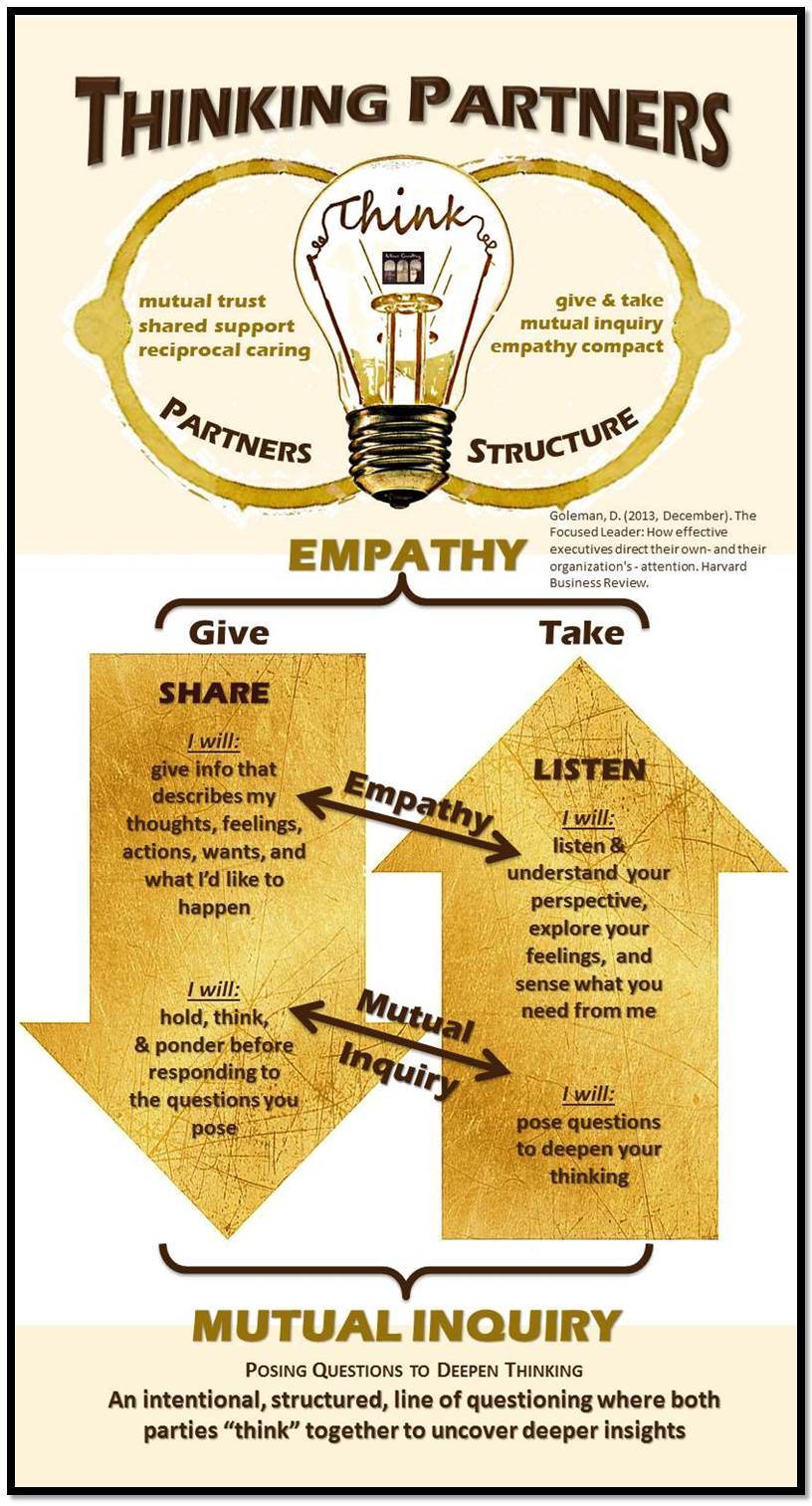
Thinking Partners is not simply a person or a role, but rather a concept that includes the roles of both partners and the structure of the conversation. It can be defined as a structured, thinking-sharing-listening-reflecting session in which:
- one person thinks out loud
- the other person listens and asks questions to deepen thinking
Thinking Partners is a Concept & a Compact
Select a Thinking Partner
Look in your circle of influence for someone you are comfortable with. You and your thinking partner should:
- share mutual trust
- genuinely care for each other as individuals
- be able to support each other’s commitment statement
Agree on Structure
Thinking partner sessions are best done in person, but can be done in a video format like FaceTime or Skype. As a last resort you may speak by telephone. You and your thinking partner should agree to:
- practice empathy
- engage in mutual inquiry
What will you “think “about during the sessions? Possible topics are:
- reaction to things you are trying
- reflection on actions you have taken
- new ideas you are considering
- concerns you have
- things you are avoiding
As you think out loud, your partner will listen with intent and then pose questions to deepen your thinking and offer you new perspectives.
Questions to Deepen your Thinking
- Do you routinely include structured reflection in your work?
- Do you ask others for help in “thinking things through”?
- Do you look to others for new perspectives or to shift your thinking?
Related Posts
Mutual Inquiry: 8 Steps to Deepen & Shift Thinking
Transformational vs. Transactional: 2 Things a Leader Needs
Setting Meaningful Goals: 3 Components of a Commitment
The DOs and DON’Ts of Curious Listening: Tell Me More
Credits
Goleman, D. (2013, December). The Focused Leader:How effective executives direct their own – and their organization’s – attention. Harvard Business Review.
Knowles, M. (1984). The Adult learner: A neglected species. Houston: Gulf Publishing Company.



 Masterpiece Leader Blog
Pingback: Transformational vs. Transactional: 2 Things a Leader Needs | Masterpiece Leader Blog
Pingback: Mutual Inquiry: 8 Steps to Deepen & Shift Thinking | Masterpiece Leader Blog
Pingback: The DOs & DON’Ts of Curious Listening: Tell Me More | Masterpiece Leader Blog
Pingback: 6 Steps to Build Engagement & Development into your Meetings: STRUCTURED GROUP REFLECTION | Masterpiece Leader Blog
Pingback: Build Empathy into Your Interactions: Part 1 | Masterpiece Leader Blog
Pingback: Build Empathy into Your Interactions Part 2: Climbing the Ladder of Inference | Masterpiece Leader Blog